

Dec 15, 2025 DEX-450 Exam Crack Test Engine Dumps Training With 202 Questions
Obtain the DEX-450 PDF Dumps Get 100% Outcomes Exam Questions For You To Pass
In addition to Apex and Visualforce, the DEX-450 exam covers Lightning Components, which are reusable building blocks for building custom applications in the Lightning Experience. This includes concepts such as event-driven architecture, component composition, and component communication. DEX-450 exam also covers best practices for testing and debugging Apex code, as well as the use of development tools such as the Salesforce Developer Console and the Force.com IDE.
NEW QUESTION # 96
A developer writes a trigger on the Account object on the before update event that increments a count field. A workflow rule also increments the count field every time that an Account is created or update. The field update in the workflow rule is configured to not re-evaluate workflow rules. What is the value of the count field if an Account is inserted with an initial value of zero, assuming no other automation logic is implemented on the Account?
- A. 0
- B. 1
- C. 2
- D. 3
Answer: C
NEW QUESTION # 97
A developer needs to have records with specific field values in order to test a new Apex class.
What should the developer do to ensure the data is available to the test?
- A. Use SOQL to query the org for the required data.
- B. Use Test.loadDataO < > and reference a CSV file in a static resource.
- C. Use Test.loadDataO and reference a JSON file in Documents.
- D. Use Anonymous Apex to create the required data.
Answer: B
NEW QUESTION # 98
A developer has a Visualforce page and custom controller to save Account records. The developer wants to display any validation rule violations to the user.
How can the developer make sure that validation rule violations are displayed?
- A. Use a try/catch with a custom exception class.
- B. Perform the DML using the patabase.upsert () method.
- C. Include <apex:messages> on the Visualforce page.
- D. Add custom controller attributes to display the message.
Answer: C
Explanation:
When saving records using a custom controller in a Visualforce page, validation rule violations can occur. To display these validation error messages to the user, the developer should use the <apex:messages> component.
Option A: Include <apex:messages> on the Visualforce page.
Correct Approach.
The <apex:messages> component displays all messages that were generated for all components on the page, including validation rule violations.
When a DML operation is performed, any validation errors are automatically added to the ApexPages message collection.
Including <apex:messages> in the page ensures that these messages are displayed to the user.
Example:
<apex:page controller="CustomAccountController">
<apex:form>
<apex:messages />
<!-- Form fields for Account -->
<apex:commandButton action="{!saveAccount}" value="Save" />
</apex:form>
</apex:page>
While a try/catch block can catch exceptions, it is not required for displaying validation errors.
Validation rule violations are added to the message collection automatically.
Using try/catch may suppress the standard error handling.
Option C: Add custom controller attributes to display the message.
Inefficient Approach.
Manually adding controller attributes and logic to handle error messages adds unnecessary complexity.
The standard <apex:messages> component handles this automatically.
Option D: Perform the DML using the Database.upsert() method.
Not Sufficient Alone.
Using Database.upsert() allows for finer control over DML operations and error handling.
However, unless the errors are added to the message collection, they will not be displayed.
The developer would still need to handle displaying the errors.
Conclusion:
By including the <apex:messages> component on the Visualforce page, validation rule violations and other error messages are displayed to the user automatically.
Therefore, Option A is the correct answer.
Reference:
apex
https://developer.salesforce.com/docs/atlas.en-us.pages.meta/pages/pages_compref_messages.htm Displaying Errors Option B: Use a try/catch with a custom exception class.
Not Necessary.
NEW QUESTION # 99
A developer wants to get access to the standard price book in the org while writing a test class that covers an OpportunitylLineltem trigger.
Which method allows access to the price book?
- A. Use Test.loadData() and a static resource to load a standard price book,
- B. Use @IaTest (SeeAllData=true) and delete the existing standard price book,
- C. Use @TestVisible to allow the test method to see the standard price book.
- D. Use Teat.getStandardPricebookId() to get the standard price book 1D.
Answer: D
Explanation:
Option D: Use Test.getStandardPricebookId() to get the standard price book ID.
Correct Answer.
The Test.getStandardPricebookId() method returns the ID of the standard price book, which can be used in test classes without using SeeAllData=true.
This allows the test to access and use the standard price book in a controlled manner.
Using SeeAllData=true is discouraged as it can make tests dependent on org data.
Deleting data in tests can have unintended consequences.
Option B: Use Test.loadData() and a static resource to load a standard price book.
Unnecessary.
There's no need to load a standard price book via Test.loadData() when Test.getStandardPricebookId() is available.
Option C: Use @TestVisible to allow the test method to see the standard price book.
Incorrect Use of @TestVisible.
@TestVisible is used to expose private members to test classes, not to access data.
Conclusion:
The developer should use Test.getStandardPricebookId() to get the standard price book ID, which is Option D.
Reference:
Accessing the Standard Price Book in Tests
Option A: Use @IsTest(SeeAllData=true) and delete the existing standard price book.
Not Best Practice and Risky.
NEW QUESTION # 100
What are two valid options for iterating through each Account in the collection List<Account> named AccountList? (Choose two.)
- A. for (List L : AccountList) {...}
- B. for(AccountList) {...}
- C. for (Integer i=0; i < AccountList.Size(); i++) {...}
- D. for (Account theAccount : AccountList) {...}
Answer: C,D
NEW QUESTION # 101
A company's engineering department is conducting a month-long test on the scalability of an in-house-developed software that requires a cluster of 100 or more servers. Which of the following models is the best to use?
- A. PaaS
- B. SaaS
- C. laaS
- D. BaaS
Answer: C
Explanation:
Infrastructure as a Service (IaaS) is the best model for the scenario described because it provides on-demand access to compute, storage, and networking resources that are ideal for a scalable server cluster. IaaS allows the engineering team to rent infrastructure resources without having to invest in physical hardware, making it perfect for temporary or fluctuating workloads, such as scalability testing.
Key Characteristics of IaaS:
Full control over the operating systems and applications running on the servers.
Flexible resource allocation to support high scalability.
Ideal for custom software testing where specific server configurations may be needed.
Why not the other options?
PaaS (Platform as a Service):
While PaaS is excellent for application development and deployment, it abstracts the infrastructure layer, which would limit the engineering team's control over the cluster's configuration.
SaaS (Software as a Service):
SaaS delivers fully managed applications, not infrastructure or testing environments. It's irrelevant for this use case.
BaaS (Backend as a Service):
BaaS is tailored to mobile or web application backend development, providing APIs and pre-built services, not infrastructure for a server cluster.
Platform Developer Reference:
While this question is broader than Salesforce-specific concepts, understanding IaaS vs. PaaS is relevant when working with Salesforce development. For example:
Salesforce operates as a PaaS (e.g., Force.com platform), allowing developers to build and deploy applications without managing underlying servers.
Testing scalability and performance at an infrastructure level (as in the question) would fall under IaaS concepts, which Salesforce developers might encounter when integrating external services or infrastructure like AWS, Azure, or Google Cloud.
This foundational knowledge complements your understanding of cloud services in the Salesforce ecosystem.
NEW QUESTION # 102
What are two characteristics related to formulas?
Choose 2 answers
- A. Formulas can reference themselves.
- B. Formulas are calculated at runtime and are not stored in the database.
- C. Formulas can reference values in related objects.
- D. Fields that are used in a formula field can be deleted or edited without editing the formula.
Answer: B,C
Explanation:
When working with formula fields in Salesforce, it's important to understand their characteristics and limitations.
Option A: Formulas are calculated at runtime and are not stored in the database.
True.
Formula fields are calculated dynamically whenever the record is accessed.
The value is not stored in the database; instead, it is computed on-the-fly based on the formula definition.
Formula fields can reference fields on related parent objects via lookup or master-detail relationships.
This allows formulas to display data from related records.
Formulas cannot reference themselves directly or indirectly.
Doing so would create a circular reference, which is not allowed.
If a field used in a formula is deleted, the formula becomes invalid.
If a field is edited (e.g., data type change), it may impact the formula's validity.
Reference:
Formula Fields Overview
Formula Fields Considerations
Option C: Formulas can reference values in related objects.
True.
Using Cross-Object Formulas
Advanced Formula Fields
Incorrect Options:
Option B: Formulas can reference themselves.
False.
Formula Field Limitations
Option D: Fields that are used in a formula field can be deleted or edited without editing the formula.
False.
Managing Formula Fields
Conclusion:
The correct characteristics related to formulas are A and C.
NEW QUESTION # 103
A developer has requirement to write Apex code to update a large number of account records on a nightly basis. The system administrator needs to be able to schedule the class to run after business hours on an as-needed basis.
Which class definition should be used to successfully implement this requirement?
- A. Global inherited sharing class ProcessAccountProcessor implements
Database. Batchable<sObject> - B. Global inherited sharing class ProcessAccountProcess Implements Queueable
- C. Global inherited sharing class ProcessAccount Process implements Queueable
- D. Gloabal inherited sharing class processAccount Processor implements Database>Bachable<sObject> Schedulable.
Answer: B
NEW QUESTION # 104
A developer created a Visualforce page and custom controller to display the account type field as shown below.
Custom controller code: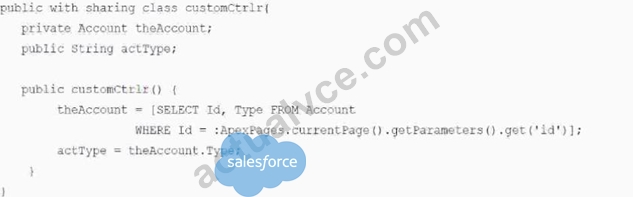
Visualforce page snippet:
The value of the account type field is not being displayed correctly on the page. Assuming the custom controller is properly referenced on the Visualforce page, what should the developer do to correct the problem?
- A. Convert theAcccunt, type to a String.
- B. Add a getter method for the actType attribute.
- C. Change theAccount attribute to public.
- D. Add with sharing to the custom controller.
Answer: B
NEW QUESTION # 105
A developer wants to send an outbound message when a record meets a specific criteria.
Which two features satisfy this use case?
Choose 2 answers
- A. Flow Builder can be used to check the record criteria and send an outbound message.
- B. Next Best Action can be used to check the record criteria and send an outbound message.
- C. Entitlement Process can be used to check the record criteria and send an outbound message without Apex code.
- D. Approval Process can be used to check the record criteria and send an outbound message without Apex code.
Answer: A,D
Explanation:
To send an outbound message when a record meets specific criteria without using Apex code, we can use features that support outbound message actions.
Option B: Approval Process can be used to check the record criteria and send an outbound message without Apex code.
Correct Feature.
An Approval Process can include outbound message actions.
When a record enters a specific step of the approval process, an outbound message can be sent.
Criteria can be defined to determine when the approval process starts.
Flow Builder supports the "Send Outbound Message" action.
A flow can be configured to trigger when records meet specific criteria and send an outbound message.
This allows for declarative automation without Apex code.
Entitlement Processes are used to manage support entitlements and service contracts.
They do not support outbound message actions.
Option C: Next Best Action can be used to check the record criteria and send an outbound message.
Incorrect.
Next Best Action (Einstein Next Best Action) is used to recommend actions to users.
It is not used to send outbound messages.
Conclusion:
The two features that satisfy the use case are:
Option B: Approval Process.
Option D: Flow Builder.
Both can evaluate record criteria and send an outbound message without the need for Apex code.
Reference:
Approval Processes
Approval Process Actions
Option D: Flow Builder can be used to check the record criteria and send an outbound message.
Correct Feature.
Flows and Outbound Messages
Flow Builder
Options Not Suitable:
Option A: Entitlement Process can be used to check the record criteria and send an outbound message without Apex code.
Incorrect.
NEW QUESTION # 106
A developer wants to get access to the standard price book in the org while writing a test class that covers an OpportunityLineltem trigger.
Which method allows access to the price book?
- A. Use Test .getStandardPricebookid() to get the standard price book ID.
- B. Use @isTest [SeeAllData=true| and delete the existing standard price book.
- C. Use @Testvisible to allow the test method to see the standard price book.
- D. Use Test. loadData () and a static resource to load a standard price book.
Answer: A
NEW QUESTION # 107
When a user edits the Postal Code on an Account, a custom Account text field named ''Timezone'' must be updated based on the values in a postalCodeToTimezone_c custom object.
What should be built to implement this feature?
- A. Account custom trigger
- B. Account assignment rule
- C. Account approval process
- D. Account workflow rule
Answer: A
NEW QUESTION # 108
Given the following code snippet, that is part of a custom controller for a Visualforce page: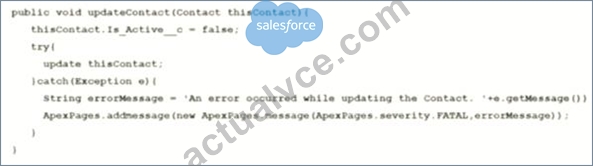
In which two ways can the try/catch be enclosed to enforce object and field-level permissions and prevent the DML statement from being executed if the current logged-in user does not have the appropriate level of access? Choose 2 answers
- A. Use if (Schema.sObjectType.Contact.isAccessible ( ) )
- B. Use if (Schema, sobjectType, Contact, isUpdatable ( ) )
- C. Use if (Schema , sobjectType. Contact. Field, Is_Active_c. is Updateable ( ) )
- D. Use if (thisContact.Owner = = UserInfo.getuserId ( ) )
Answer: B,C
NEW QUESTION # 109
A Visual Flow uses an apex Action to provide additional information about multiple Contacts, stored in a custom class, contactInfo. Which is the correct definition of the Apex method that gets additional information?
- A. @InvocableMethod(label='Additional Info')
public List<ContactInfo> getInfo(List<Id> contactIds)
{ /*implementation*/ } - B. @InvocableMethod(label='additional Info')
public static ContactInfo getInfo(Id contactId)
{ /*implementation*/ } - C. @invocableMethod(label)='Additional Info')
public static List<ContactInfo> getInfo(List<Id> contactIds)
{ /*Implementation*/ } - D. @InvocableMethod(Label='additional Info')
public ContactInfo(Id contactId)
{ /*implementation*/ }
Answer: C
NEW QUESTION # 110
A developer is creating an app that contains multiple Lightning web components.
One of the child components is used for navigation purposes. When a user click a button called.. component, the parent component must be alerted so it can navigate to the next page.
How should this be accomplished?
- A. Create a custom event.
- B. Call a method in the Apex controller.
- C. Fire a notification.
- D. Update a property on the parent.
Answer: A
NEW QUESTION # 111
A lead developer creates an Apex interface called "Laptop". Consider the following code snippet:
How can a developer use the Laptop Interface within the Silvertaptop class?
- A. @Interface (class=''Laptop'')
public class SilverLaptop - B. @Extends(class=Laptop'')
public class SilverLaptop - C. public class Silverlaptop implements Laptop
- D. public calss SilverLaptop extends Laptop
Answer: D
NEW QUESTION # 112
What are three capabilities of the <ltng:require> tag when loading JavaScript resources in Aura components?
Choose 3 answers
- A. One-time loading for duplicate scripts
- B. Loading scripts in parallel
- C. Specifying loading order
- D. Loading files from Documents
- E. Loading externally hosted scripts
Answer: A,C,E
Explanation:
Option A: Specifying loading order
True.
The <ltng:require> tag allows you to specify the order in which scripts are loaded by the sequence in the scripts attribute.
Scripts loaded using <ltng:require> are loaded only once, even if multiple components request the same script, preventing redundant loads.
You can load scripts from external URLs, such as Content Delivery Networks (CDNs), using the scripts attribute.
<ltng:require> cannot load files from the Documents object. It loads resources from static resources or external URLs.
Scripts are loaded sequentially, not in parallel, to ensure dependencies are properly resolved.
Reference:
Include External JavaScript and CSS Libraries
Option B: One-time loading for duplicate scripts
True.
Loading JavaScript Libraries
Option D: Loading externally hosted scripts
True.
Using External Libraries
Option C: Loading files from Documents
False.
Static Resources
Option E: Loading scripts in parallel
False.
Scripts Loading Order
Conclusion:
The three capabilities are A, B, and D.
NEW QUESTION # 113
A developer needs to allow users to complete a form on an Account record that will create a record for a custom object. The form needs to display different fields depending on the user's job role. The functionality should only be available to a small group of users.
Which three things should the developer do to satisfy these requirements?
Choose 3 answers
- A. Create a Lightning web component.
- B. Create a dynamic form.
- C. Create a custom permission for the users.
- D. Add a dynamic action to the user's assigned page layouts.
- E. Add a dynamic action to the Account record page.
Answer: B,C,E
NEW QUESTION # 114
Which annotation exposes an Apex class as a RESTful web service?
- A. HttpInvocable
- B. AuraEnabled
- C. RestResource
- D. RemoteAction
Answer: C
NEW QUESTION # 115
A developer needs to create a custom button for the Account object that, when clicked, will perform a series of calculation and redirect the user to a custom visualforce page.
Which three attributes need to be defined with values in the <apex:page> tag to accomplish this?
Choose 3 answers
- A. standard Controller
- B. extensions
- C. Action
- D. renderAs
- E. readOnly
Answer: A,C,D
NEW QUESTION # 116
A company has a custom object named Region. Each account in salesforce can only be related to one region at a time, but this relationship is optional. Which type of relantionship should a developer use to relate an account to a region?
- A. Lookup
- B. Master-detail
- C. Parent-child
- D. Hierarchical
Answer: B
NEW QUESTION # 117
......
DEX-450 Exam Dumps Contains FREE Real Quesions from the Actual Exam: https://buildazure.actualvce.com/Salesforce/DEX-450-valid-vce-dumps.html